My practice explores the relationship between structure, uncertainty and collective listening. Working as an improvising guitarist and composer, I create systems that invite rather than determine musical outcomes. I am interested in the ways carefully designed frameworks can enable freedom: how shared structures can create the confidence for performers to take risks, listen deeply and discover unexpected musical possibilities together.
Improvisation sits at the centre of my work, but I understand improvisation less as an act of individual expression than as an act of listening. It is a process of attention, dialogue and responsiveness in which music emerges through the relationships between performers. Rather than presenting a finished composition, I seek to create the conditions from which a performance can unfold collectively, allowing each musician to contribute their own experience, intuition and imagination.
My recent experimental composition work explores randomly generated twelve-tone rows and matrices as frameworks for collaborative improvisation and graphic notation. These systems are not intended to recreate the principles of serial composition, nor do they prescribe musical outcomes. Instead, they function as shared reference points: visual and conceptual maps that orient performers while leaving space for interpretation, negotiation and spontaneity. Constraint becomes a creative catalyst rather than a limitation. The framework provides enough structure for uncertainty to become productive, allowing every performance to develop differently while remaining connected by a common set of relationships.
I am drawn to the creative tension between order and unpredictability. Rather than seeing these as opposing forces, I regard them as mutually dependent. Structure creates a shared environment in which freedom becomes possible; uncertainty gives those structures meaning by allowing them to be inhabited differently each time. The resulting performances exist somewhere between composition and improvisation, intention and chance, planning and discovery.
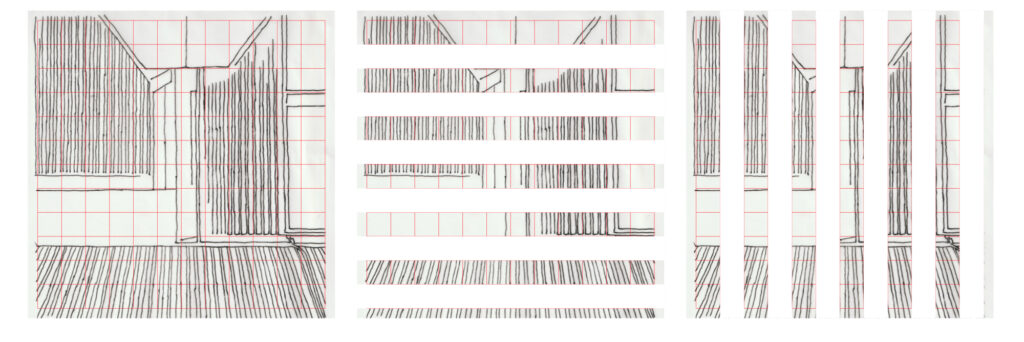
My practice is informed by the experimental traditions of composers such as John Cage and Morton Feldman, the work of contemporary composers including Mauro Lanza and Magnus Granberg, and the radical listening practices of British free improvisation. I am equally influenced by visual artists including Agnes Martin and Nasreen Mohamedi, particularly in their explorations of repetition, geometry, space and subtle variation. Their use of grids and systems as frameworks for perceptual and intuitive experience resonates strongly with my own interest in the relationship between structure and uncertainty. Together, these influences encourage me to think of notation not simply as instruction, but as an environment within which performers can navigate, interpret and collaborate.
Increasingly, I understand my work as a form of artistic enquiry. I am interested in questions such as: How can compositional systems encourage rather than constrain improvisation? How do performers negotiate freedom within shared structures? In what ways does a predetermined framework change the way musicians listen, respond and make decisions together? These questions have also led me to reflect on my own relationship with structure and routine, and whether my experience as an autistic person has shaped my attraction to systems that provide orientation while leaving room for unpredictability. This is not a conclusion but an ongoing area of research that continues to inform the development of my practice.
Whether working through experimental composition, graphic scores, indeterminate notation, free improvisation or collaborative performance, my aim is not to control musical outcomes but to design conditions in which creativity can emerge collectively. I am interested in creating work that invites curiosity, attentive listening and shared exploration, where composition becomes less about prescribing sound and more about creating possibilities for human interaction. Each performance is therefore not simply a presentation of a work, but a unique negotiation between structure and freedom, revealing new relationships between performers, audiences and the systems that bring them together.